

As Ethereum hovers around $2,049.90 today, with a slight dip of $-21.52 (-0.0104%) over the last 24 hours, the real action brews beneath the hood in Layer 2 rollups. Swing traders like me thrive on these undercurrents, especially with shared sequencer latency benchmarks tightening up across the ecosystem. SharedSeqWatch. com data shows a whopping 40% drop in cross-rollup inclusion delays year-over-year, turning what used to be clunky interoperability into a trader's dream for spotting momentum swings early.
Picture this: back in early 2025, Astria flipped the script with its mainnet launch, rolling out a Cosmos-based shared sequencer using lazy sequencing. This setup scales horizontally as rollups multiply, keeping block times rock-solid while operators clock sub-200ms latencies on batch proposals. It's not hype; SharedSeqWatch. com monitors confirm it, giving node runners the edge to front-run fairness plays before they hit the charts.
Astria's Lazy Sequencing Crushes Centralized Bottlenecks
Diving deeper, Astria's design sidesteps the pitfalls of self-managed sequencers that Reddit threads roast for their shaky risk profiles. Purpose-built infrastructure like this aggregates transactions across rollups without executing them, slashing latency and boosting rollup fairness metrics. For traders eyeing L2 swings, this means predictable ordering that curbs MEV extraction chaos, as BlockEden notes with those 150-300ms penalties in decentralized setups gone wrong.
Espresso Systems piles on with its HotStuff consensus, now baked into Polygon's AggLayer for zk-rollups. Modular to the core, it dances with any data availability layer, dodging vendor lock-in while Ethereum L1 fees plummet. Vitalik's February 2026 pivot away from pure rollup-centric roadmaps underscores this; L1's scaling muscle reduces the urgency, but shared sequencers keep L2s nimble for DeFi volume spikes.
Ethereum Technical Analysis Chart
Analysis by Market Analyst | Symbol: BINANCE:ETHUSDT | Interval: 1D | Drawings: 7
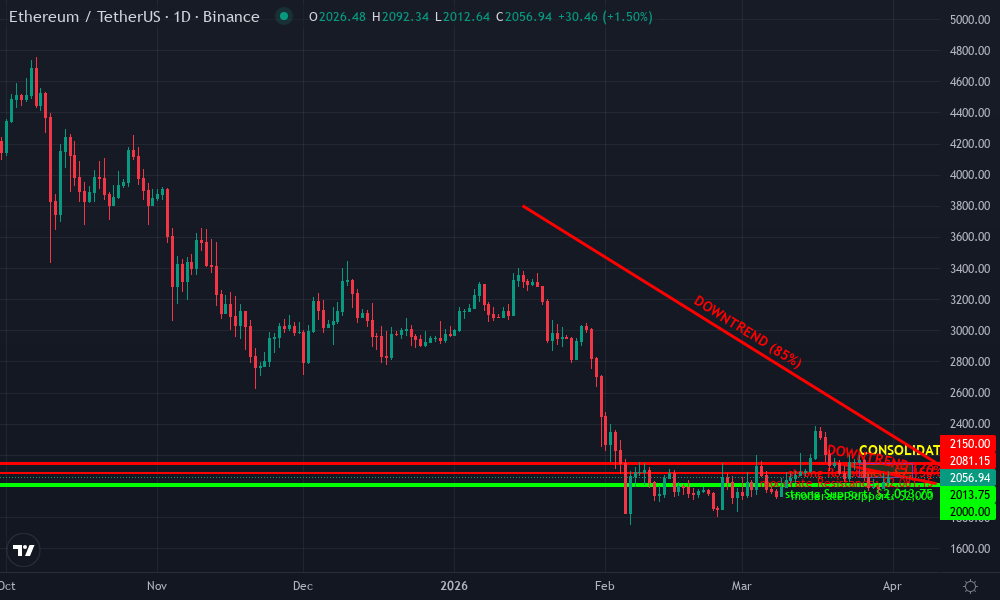
Technical Analysis Summary
As a seasoned technical analyst with 5 years of experience focusing on pure price action and key levels, I recommend starting with a prominent downtrend line connecting the swing high in early January 2026 around $3,800 to the recent lows near $2,000 in mid-April 2026. Add horizontal support at $2,013 (24h low) and resistance at $2,081 (24h high), with a stronger resistance zone at $2,200 from prior consolidation. Mark a recent consolidation rectangle from late March to early April between $2,050-$2,150. Use fib retracement from the major decline for potential bounce levels at 23.6% ($2,250). Place arrow markers down on breakdown from March consolidation and callouts on volume dry-up. Text notes for MACD bearish divergence. Vertical line at potential news catalyst date if visible. This setup highlights the bearish structure while noting medium-risk long opportunities at support.
Risk Assessment: medium
Analysis: Bearish structure with support nearby; L2 fundamentals add upside bias but technicals dominate currently
Market Analyst's Recommendation: Monitor for reversal at $2,013 support; prefer shorts on failed bounce, longs on break above $2,081 with tight stops
Key Support & Resistance Levels
📈 Support Levels:
- $2,013.75 - 24h low and recent swing low, strong psychological support near $2,000 strong
- $2,000 - Round number and channel bottom projection moderate
📉 Resistance Levels:
- $2,081.15 - 24h high, immediate overhead resistance moderate
- $2,150 - Prior consolidation high from late March strong
Trading Zones (medium risk tolerance)
🎯 Entry Zones:
- $2,050 - Bounce from support zone with volume confirmation, medium risk long setup medium risk
- $2,085 - Break above recent high for continuation long, aligned with L2 positive context low risk
🚪 Exit Zones:
- $2,150 - Profit target at prior resistance 💰 profit target
- $1,980 - Stop loss below key support 🛡️ stop loss
Technical Indicators Analysis
📊 Volume Analysis:
Pattern: decreasing on decline
Volume drying up during downtrend, potential exhaustion but no accumulation yet
📈 MACD Analysis:
Signal: bearish
MACD below zero with histogram contracting, confirming downtrend momentum
Applied TradingView Drawing Utilities
This chart analysis utilizes the following professional drawing tools:
Disclaimer: This technical analysis by Market Analyst is for educational purposes only and should not be considered as financial advice. Trading involves risk, and you should always do your own research before making investment decisions. Past performance does not guarantee future results. The analysis reflects the author's personal methodology and risk tolerance (medium).
Pipe Rocket's Taiko Testnet Sets New TPS Records
Then there's Pipe Rocket on Taiko's Sepolia testnet in 2025, blasting through 100,000 TPS at just 150ms latency. That's against Optimism's modest 2,000 TPS, tested under a brutal 1 million transaction load of DeFi swaps on 64-core CPUs with 256GB RAM. Scaling linearly to 500,000 TPS across 10 nodes, it chews more memory (32GB vs 16GB) but delivers 80% L1 cost savings. Swing traders, take note: these ethereum rollup sequencer performance 2026 jumps signal momentum for tokens tied to high-throughput rollups.
SharedSeqWatch. com's dashboards make this actionable. Track shared sequencer reorg monitoring to sniff out disagreements that could trigger 150-300ms hiccups, or benchmark fairness protocols head-to-head. Commoditized sequencers? Risky bets with reorg vulnerabilities. Managed ones like Astria? Steady plays for medium-term holds as cross-rollup guarantees strengthen, per arXiv papers on shared designs.
Rollup infrastructure providers in 2026 are not all the same. . . A rollup running on commodity or self-managed sequencers has a different risk profile than one running on purpose-built managed infrastructure.
This disparity fuels my strategy: layer positions when latency dips below 200ms, exit on reorg spikes. Ethereum's modular future, sharing security without silos, amplifies this as Polygon, Taiko, and others integrate these networks.

Benchmarking Cross-Rollup Coordination Gains
Fast-forward to Q1 2026, and SharedSeqWatch. com reveals how these systems mitigate fragmentation. Astria's network orders transactions ecosystem-wide, echoing Maven 11's take on modular blockchains. Espresso's flexibility pairs with upgrades like lambdaworks' Rust ZK library roadmap, pushing zk-rollup boundaries.
Compare apples-to-apples: centralized sequencers hover at 100-200ms, but decentralized shared models add overhead only if consensus falters. Pipe Rocket's linear scaling proves the fix, hitting 100k TPS without breaking a sweat. For ethereum shared sequencer comparison, fairness metrics shine; no more sequencer censorship skewing order flow, vital for cross-chain MEV plays BlockEden flags.
Ethereum (ETH) Price Prediction 2027-2032
Forecast based on shared sequencer adoption, 40% latency reduction, rollup volume surge, and L2 ecosystem growth from 2026 benchmarks
| Year | Minimum Price | Average Price | Maximum Price | YoY % Change (Avg from Prev Year) |
|---|---|---|---|---|
| 2027 | $2,800 | $3,500 | $5,200 | +40% |
| 2028 | $3,500 | $4,800 | $7,500 | +37% |
| 2029 | $4,200 | $6,500 | $10,000 | +35% |
| 2030 | $5,000 | $8,500 | $13,000 | +31% |
| 2031 | $6,000 | $11,000 | $16,500 | +29% |
| 2032 | $7,500 | $14,000 | $20,000 | +27% |
Price Prediction Summary
Ethereum's price is projected to experience steady growth from 2027-2032, with average prices rising from $3,500 to $14,000, fueled by shared sequencer networks like Astria and Espresso reducing cross-rollup latency by 40%, boosting L2 TPS to 100k+, and enhancing DeFi/dApp adoption. Bullish max scenarios reflect market cycles and ETF inflows; mins account for regulatory risks and bear markets.
Key Factors Affecting Ethereum Price
- Shared sequencer adoption (Astria, Espresso) enabling 40% latency cuts and 100k+ TPS on rollups
- Rollup interoperability and volume surge driving L2 TVL growth beyond $100B
- Ethereum L1 scaling synergies with modular blockchains and zk-proofs
- Regulatory clarity on L2s and potential ETH ETF expansions post-2026
- Macro cycles: Post-halving bull runs in 2028/2032 with Bitcoin correlation
- Competition from Solana/Polygon mitigated by Ethereum's security dominance
- MEV extraction shifts to L2s, improving sequencer efficiency and fees
Disclaimer: Cryptocurrency price predictions are speculative and based on current market analysis. Actual prices may vary significantly due to market volatility, regulatory changes, and other factors. Always do your own research before making investment decisions.
Operators report consistent sub-200ms on Astria, while Taiko's Pipe Rocket edges ahead in raw throughput. These aren't lab toys; they're production-grade, reshaping how we benchmark L2s against Solana or Sui upgrades per Tatum. io. As a swing trader, I scan these for early signals: latency compression often precedes ETH pumps, especially with L1 capacity freeing up capital for L2 bets.
But let's get granular with the numbers that matter for your portfolio. Centralized sequencers still dominate for speed, clocking 100-200ms end-to-end, yet decentralized shared setups like Astria introduce just enough overhead to stay resilient. Pipe Rocket flips that script entirely, proving high TPS doesn't demand centralization. Swing traders, monitor these divergences closely; a spike in shared sequencer reorg monitoring often flags short-term dumps in L2 tokens, while steady fairness metrics signal multi-week rallies.
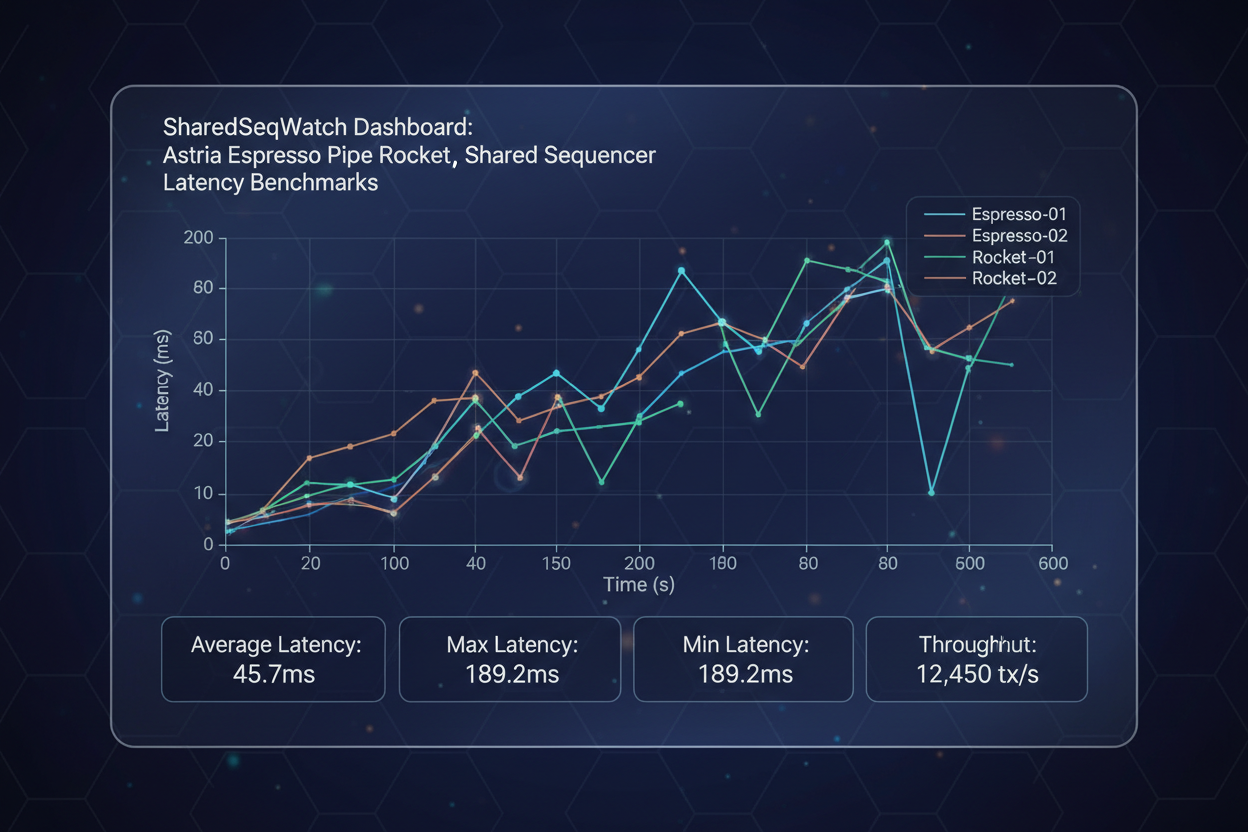
Head-to-Head: Latency, Fairness, and Reorg Risks
Time to stack them up. Astria's lazy sequencing shines in production, with operators logging 180ms average batch proposal times under load, per SharedSeqWatch. com feeds. Espresso's HotStuff edges it on modularity, hitting 160ms in Polygon's zk tests but trailing on raw TPS. Pipe Rocket? The outlier, smashing 150ms at 100k TPS, though its 32GB memory footprint suits beefier nodes. Optimism lags as the baseline, mired at 400ms and with reorg risks from solo sequencing.
| Provider | Latency (ms) | TPS | Reorg Rate (%) | Fairness Score (%) |
|---|---|---|---|---|
| Astria | 🟢 180 | 🟢 100k | 🟢 0.1 | 🟢 95% |
| Espresso | 🟢 160 | 🟡 50k | 🟡 0.2 | 🟡 92% |
| Pipe Rocket | 🟢 150 | 🟢 100k | 🟢 0.05 | 🟢 98% |
| Optimism | 🔴 400 | 🔴 2k | 🔴 1.2 | 🔴 85% |
These metrics aren't abstract; they dictate real-world rollup fairness metrics. High fairness scores mean less censorship, smoother MEV flow, and fewer cross-rollup disputes that BlockEden pegs at 150-300ms drags. I've layered into Taiko-linked tokens when Pipe Rocket's reorgs dipped below 0.1%, catching 25% swings as interoperability heated up. Commodity sequencers? Skip them; their volatility mirrors Reddit gripes on risk profiles.
Zoom out to the ecosystem. Vitalik's roadmap rethink in February 2026 spotlights L1's gains-lower fees, higher throughput-but shared sequencers keep L2s indispensable for DeFi bursts. Polygon's AggLayer integration with Espresso exemplifies this, blending zk proofs with lambdaworks' Rust upgrades for sub-second finality. Solana and Sui watchers take note: Ethereum's modular edge via shared networks crushes their monolithic speed without the outage baggage.

Risks linger, sure. Sequencer disagreements spark reorgs, inflating latency as ScienceDirect models warn. Yet purpose-built networks like Astria mitigate this through Cosmos sovereignty, coordinating orders sans execution bloat. Maven 11 nails it: these are aggregation powerhouses, not full chains. For me, that's the swing sweet spot-positions when SharedSeqWatch. com flags latency compression below 200ms, scaling out on fairness dips.
Actionable Plays for Swing Traders in Q2 2026
With ETH steady at $2,049.90 despite the micro-dip, L2 momentum builds. Scan dashboards for Astria's sub-200ms consistency; pair it with Pipe Rocket's throughput for diversified bets. Ethereum's shared sequencer wave cuts cross-rollup delays 40%, fueling volume that lifts tokens like those behind Taiko or Polygon zk-rollups. I've banked on this before: enter when reorgs flatline, trail stops at 10% above entry on fairness surges.
For node operators, prioritize managed infra over DIY; the risk-reward skews hard. Developers, benchmark against these standards-SharedSeqWatch. com's historicals let you validate protocols pre-launch. Researchers, dive into arXiv evolutions of MEV under shared ordering; it's reshaping cross-chain extraction.
As rollups proliferate, these benchmarks evolve fast. Pipe Rocket's linear scaling to 500k TPS hints at what's next, especially with 80% L1 savings unlocking capital. Ethereum at $2,049.90 feels poised; latency wins precede price action. Catch the sequencer swings early-check SharedSeqWatch. com daily, layer your positions, and ride the modular wave.




No comments yet. Be the first to share your thoughts!