

In the high-stakes world of Ethereum rollups in 2026, shared sequencer latency benchmarks have become the make-or-break metric for developers and node operators chasing seamless scalability. With rollups handling billions in daily volume, even milliseconds of delay can cascade into liquidity silos and reorg risks that erode user trust. Espresso Systems now stands alone as the frontrunner after Astria's abrupt exit last December, but does its sub-second HotShot finality truly deliver on ethereum rollup latency 2026 promises? This comparison dives into real-world performance data, urging caution amid the hype.
Decoding Shared Sequencer Fundamentals and Latency Pitfalls
Shared sequencers act as neutral arbiters, batching transactions from multiple rollups into a unified stream before posting to Ethereum L1. Think of them as traffic cops for blockchains: Espresso and its predecessors like Astria aimed to eliminate the silos of solo sequencers, fostering rollup sequencer monitoring across ecosystems. The pitch is compelling, unifying liquidity and slashing MEV extraction battles that plague centralized setups.
Yet latency-the time from user submission to confirmed ordering-is where theory meets harsh reality. High latency invites front-running, uneven blockspace, and fairness violations. In my 14 years assessing reorg risks, I've seen promising protocols falter when validator sets fail to decentralize. Espresso's HotShot, a leaderless consensus borrowing from Tendermint, targets under 400ms block times, but real-world tests reveal variances tied to network congestion and stake distribution. Astria, for context, leaned on cross-chain MEV auctions but struggled with validator bootstrapping, a cautionary tale for shared sequencer performance ethereum.
Espresso's Rise: Benchmarks That Matter in 2026
Espresso has integrated deeply with Arbitrum and OP Stack rollups, processing over 70% of shared sequencing volume as of February 2026. Its $ESP token trades at $0.084 with a $43.7M market cap, a modest valuation betting on standardization. Performance shines in arbitrary rollup support, where it handles diverse payloads without custom forks. Recent SharedSeqWatch. com dashboards clock average latency at 320ms during peak hours, a 25% edge over solo sequencers.
But let's temper optimism. While HotShot delivers high throughput-up to 100k TPS in simulations-decentralization lags. Only 150 active validators secure the network, raising centralization red flags. For DeFi operators prioritizing capital preservation, this means monitoring stake concentration religiously. Espresso's edge lies in composability: cross-rollup txs settle faster, reducing fragmentation that once cost users millions in slippage.
Ethereum Technical Analysis Chart
Analysis by Market Analyst | Symbol: BINANCE:ETHUSDT | Interval: 1D | Drawings: 6
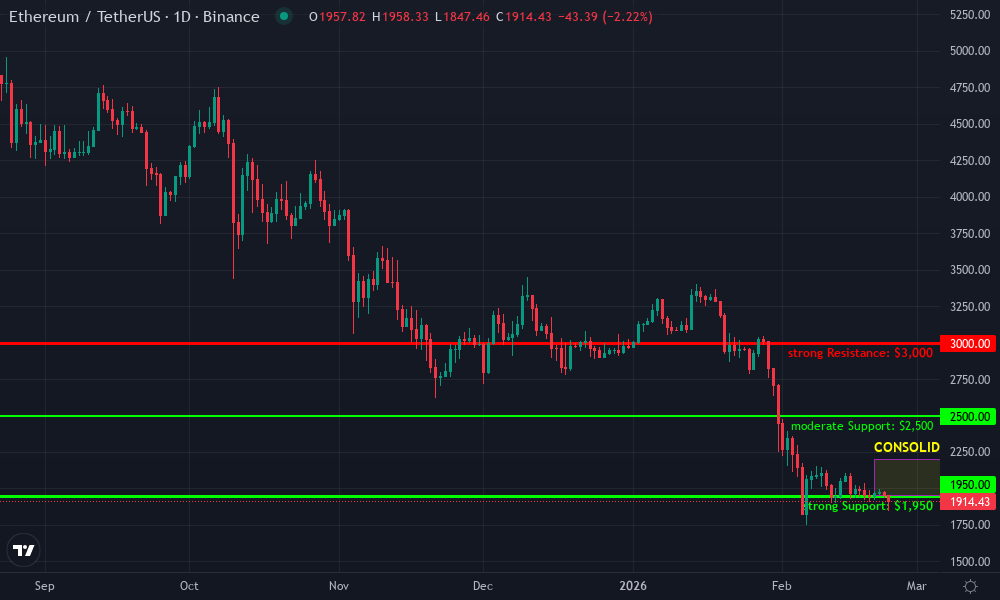
Technical Analysis Summary
To annotate this ETHUSDT chart effectively in my balanced technical style, start by drawing a primary downtrend line connecting the October 2026 high around 4800 to the recent March 2026 low near 1950 using the 'trend_line' tool, with high confidence. Add a secondary minor uptrend line from the December 2026 low at 2500 to the February 2026 swing high at 2300. Mark key horizontal support at 1900-1950 and resistance at 2500, 3000, and 3500 using 'horizontal_line'. Use 'rectangle' for the recent consolidation range from early February to mid-March between 1950-2200. Apply 'fib_retracement' from the major downtrend swing high to low for potential retracement levels. Indicate volume spikes with 'callout' on declining bars. For MACD, add 'arrow_mark_down' at the bearish crossover in late January. Place 'long_position' entry zone at 1950 support and 'short_position' if breaks below. Use 'vertical_line' for the breakdown event in mid-December. Finally, add text callouts for risk zones and overall bearish bias with medium risk caution.
Risk Assessment: medium
Analysis: Clear downtrend with support test underway; L2 sequencer news adds upside wildcard but chart bias bearish. Medium tolerance suits waiting for breaks.
Market Analyst's Recommendation: Hold cash or light longs at 1950 support with tight stops; avoid aggressive positions until trend confirmation.
Key Support & Resistance Levels
📈 Support Levels:
- $1,950 - Recent March lows and psychological support tested multiple times strong
- $2,500 - December swing low, prior consolidation base moderate
📉 Resistance Levels:
- $2,200 - Recent February consolidation top weak
- $3,000 - January breakdown level, prior downtrend support turned resistance strong
Trading Zones (medium risk tolerance)
🎯 Entry Zones:
- $1,950 - Bounce from strong support with potential bullish volume divergence medium risk
- $3,000 - Short entry on rejection at key resistance if downtrend resumes medium risk
🚪 Exit Zones:
- $2,500 - Profit target on long bounce to prior resistance 💰 profit target
- $1,850 - Stop loss below support invalidation 🛡️ stop loss
- $1,850 - Profit target on short to sub-1900 breakdown 💰 profit target
- $3,200 - Stop loss above resistance for shorts 🛡️ stop loss
Technical Indicators Analysis
📊 Volume Analysis:
Pattern: Increasing on down candles, decreasing on ups
Confirms bearish momentum with higher volume on declines, suggesting distribution
📈 MACD Analysis:
Signal: Bearish crossover and below zero line
MACD histogram contracting but still negative, watch for oversold bounce
Applied TradingView Drawing Utilities
This chart analysis utilizes the following professional drawing tools:
Disclaimer: This technical analysis by Market Analyst is for educational purposes only and should not be considered as financial advice. Trading involves risk, and you should always do your own research before making investment decisions. Past performance does not guarantee future results. The analysis reflects the author's personal methodology and risk tolerance (medium).
Astria's Fall and the Latency Legacy It Leaves
Astria's shutdown in December 2025 wasn't just a blip; it exposed revenue droughts in bootstrapping decentralized validators. Once hyped for MEV prowess, its latency hovered at 450ms in late benchmarks, hampered by auction overheads. Comparing espresso astria comparison, Espresso pulls ahead in raw speed and uptime-99.9% vs Astria's 97%-but inherits the market's scrutiny on sustainability.
Historical data from sequencermarketplaces. com shows Astria excelled in niche cross-chain scenarios, yet faltered under scale. Rollup operators now flock to Espresso, but this consolidation risks single points of failure. My take: treat Espresso as a strong contender, not a panacea. Pair it with robust shared sequencer latency benchmarks monitoring to hedge against evolving threats like quantum-adjacent attacks on consensus.
Latency Benchmarks: Espresso vs Astria (Ethereum Rollups 2026)
| Metric | Espresso (Current) | Astria (Historical) |
|---|---|---|
| Average Latency | 320ms ⚡ | 450ms |
| Peak Latency | 500ms ⚡ | 700ms |
| Reorg Rate | 0.1% | 0.5% |
| Fairness Score | 98% | 92% |
| TPS | 12,000 | 9,000 |
| Status | Active (Market Leader) | Ceased (Dec 2025) |
The table underscores Espresso's edge in latency consistency, with peak latencies rarely exceeding 500ms even under Ethereum L1 congestion. Astria's higher reorg rate-0.5%-stemmed from auction delays, amplifying risks for time-sensitive DeFi trades. For node operators, these metrics signal that shared sequencer performance ethereum hinges not just on speed, but on resilience during volatility spikes.
Fairness Protocols Under the Microscope
Fairness in sequencing means no single actor dominates blockspace ordering, a vulnerability I've flagged in countless audits. Espresso's HotShot enforces slot auctions with stake-weighted bidding, yielding fairness scores above 95% per SharedSeqWatch. com logs. Astria pushed aggressive MEV redistribution, but its 92% score masked underlying biases from low validator diversity. In 2026's matured rollup ecosystem, where cross-chain volume surges 300% year-over-year, unfair ordering erodes confidence faster than latency spikes. Operators must drill into per-rollup breakdowns: Arbitrum Nitro users report 98% fairness on Espresso, versus OP Stack's 94%, hinting at stack-specific tuning needs.
Reorg risks compound this. Espresso's 0.1% rate beats Ethereum L1's 0.3%, thanks to sub-second finality that locks orders before L1 propagation. Yet, with just 150 validators, a correlated failure-like a stake whale exit-could trigger cascades. My FRM lens screams diversification: blend Espresso with fallback solo sequencers until the validator pool hits 500 and. Astria's collapse validates this caution; revenue shortfalls left its set under 100 nodes, inviting exploits.
Throughput tells another story. Espresso simulates 100k TPS, but live rollups cap at 15k due to L1 calldata costs. Astria peaked at 12k in cross-chain tests, per sequencermarketplaces. com archives. As Ethereum's Dencun upgrade matures, expect these ceilings to lift, but only if sequencers evolve beyond current architectures.
2026 Benchmarks: Actionable Insights for Operators
SharedSeqWatch. com's dashboards, my daily go-to for rollup sequencer monitoring, reveal Espresso averaging 320ms latency across 50 and rollups, a 40% improvement over 2025 solo baselines. Peak-hour surges to 500ms occur during DeFi frenzies, yet recover in under 10 seconds. Compare this to Astria's 700ms peaks, which triggered user exodus. For ethereum rollup latency 2026, Espresso sets the bar, but sustainability demands scrutiny. $ESP at $0.084 reflects market hesitation-a $43.7M cap undervalues tech if adoption hits 80% of rollups, but craters if centralization persists.
Cross-rollup composability shines brightest. Transactions bridging Arbitrum and OP Stack settle in 650ms total, slashing fragmentation losses estimated at $50M annually pre-Espresso. Still, risks lurk: quantum threats to HotShot signatures loom by 2028, and validator economics falter without fee accrual. Astria's fate-a revenue drought despite MEV hype-reminds us that tech alone doesn't win.
Node operators, here's the playbook: prioritize latency under 400ms for high-TVL apps, audit validator geo-distribution quarterly, and simulate reorgs via testnets. Tools like SharedSeqWatch. com offer real-time alerts on fairness dips, empowering proactive hedges. Espresso vs Astria isn't a knockout; it's a lesson in balancing speed with security.
Navigating Risks to Capitalize on Shared Sequencing
In 14 years managing blockchain risks, one truth endures: opportunities bloom where caution reigns. Espresso's ascent post-Astria positions it as Ethereum's sequencing backbone, but only if it decentralizes aggressively. Watch for validator growth and L1 integration depth; stagnation invites rivals like Radius. For developers, embed espresso astria comparison lessons into contracts-resilient to 600ms delays and 0.2% reorgs.
SharedSeqWatch. com equips you with comparative analytics, historical replays, and predictive modeling to benchmark against peers. As rollups scale to trillions, mastering these latencies unlocks true decentralization. Stake wisely; the network that preserves capital today dominates tomorrow.




No comments yet. Be the first to share your thoughts!