

As Ethereum's Layer 2 ecosystem matures with ETH trading at $1,968.05, shared sequencer latency tiers have become pivotal in defining rollup performance. SharedSeqWatch. com data reveals stark differences in shared sequencer latency tiers, where sub-100ms speeds power high-frequency DeFi while slower tiers prioritize ironclad decentralization. These ethereum sequencer benchmarks expose critical rollup fairness tradeoffs, influencing reorg rates and transaction ordering reliability across networks.
Monitoring tools like SharedSeqWatch. com track these metrics in real-time, highlighting how latency directly correlates with fairness protocols and operational resilience. In today's volatile L2 landscape, understanding these tiers equips developers and operators to optimize for speed without sacrificing trustlessness.
Fast Tier Benchmarks: Under 100ms for DeFi Dominance
The Fast Tier ( and lt;100ms) stands out as ideal for high-frequency DeFi applications, delivering minimal reorgs through advanced fairness protocols. SharedSeqWatch. com benchmarks clock centralized or hybrid sequencers in this range at peak loads, processing transactions with latencies as low as 50ms. This tier shines in environments demanding instant finality, such as perpetuals exchanges or arbitrage bots, where even millisecond delays erode profitability.
Yet, precision demands scrutiny: while fast tiers minimize reorgs to under 0.1% per block, they lean on optimized consensus like HotShot's CDN-backed dissemination. Recent data from Ethereum Research's 'Becoming Based' roadmap underscores how these systems transition from centralized setups, retaining sub-100ms speeds via proposer-builder separation enhancements. At ETH's current $1,968.05 price point, DeFi volumes on fast-tier rollups have surged 15% week-over-week, per our monitoring dashboards.

Fairness here hinges on economic incentives; restaking mechanisms deter malicious ordering, but single points of coordination persist. Cube Exchange notes shared sequencers in this tier reduce cross-rollup reorgs by 40%, a boon for atomic DeFi interactions.
Medium Tier: 100-500ms Balance for Everyday Rollups
Entering the Medium Tier (100-500ms), we find a balanced profile suited for general rollups, backed by standard benchmarking and moderate fairness costs. SharedSeqWatch. com logs average latencies around 250ms, with reorg frequencies holding steady at 0.5%. This tier employs decentralized consensus protocols, like those in Arbitrum's sequencer designs, trading raw speed for broader participation.
Performance metrics paint a clear picture: under optimal conditions, HotShot variants finalize in 150ms, per Uplatz benchmarks. This makes medium tiers the workhorse for dApps spanning gaming to lending, where user experience trumps ultra-low latency. Zeeve's analysis on shared sequencers emphasizes how this range revolutionizes scalability, cutting denial-of-sequencing risks via multi-proposer rotations.
Ethereum (ETH) Price Prediction 2027-2032
Forecasts factoring L2 shared sequencer latency improvements, based sequencing, and market trends from 2026 baseline ($1,968)
| Year | Minimum Price ($) | Average Price ($) | Maximum Price ($) |
|---|---|---|---|
| 2027 | $2,200 | $3,200 | $4,800 |
| 2028 | $2,800 | $4,500 | $7,200 |
| 2029 | $3,500 | $6,000 | $10,000 |
| 2030 | $4,200 | $8,000 | $14,000 |
| 2031 | $5,000 | $10,500 | $18,000 |
| 2032 | $6,000 | $13,000 | $22,000 |
Price Prediction Summary
Ethereum's price is projected to grow steadily from 2027 to 2032, driven by L2 scalability enhancements like shared sequencers with fast/medium latency tiers, based sequencing (ePBS), and data availability cost reductions (e.g., Dencun, Euclid). Bullish scenarios reflect mass adoption in DeFi and cross-rollup execution; bearish account for regulatory hurdles and market cycles. Overall CAGR ~45% from 2026 baseline, with potential to surpass $20,000 by 2032 in optimistic conditions.
Key Factors Affecting Ethereum Price
- L2 shared sequencer advancements reducing latency and improving fairness/censorship resistance
- Based sequencing and ePBS maturation enhancing decentralization without sacrificing speed
- Dencun/EIP-4844 and Euclid upgrades slashing data costs by up to 90%
- Market cycles, institutional adoption, and regulatory developments
- Competition from Solana/other L1s and economic security via restaking/slashing
Disclaimer: Cryptocurrency price predictions are speculative and based on current market analysis. Actual prices may vary significantly due to market volatility, regulatory changes, and other factors. Always do your own research before making investment decisions.
Tradeoffs emerge in fairness costs; moderate slashing penalties ensure ordering neutrality, but network jitter can spike latencies to 400ms during congestion. Maven 11 highlights aggregated transaction ordering across rollups, preserving interoperability without fast tier's centralization pitfalls. At $1,968.05 ETH, medium-tier rollups capture 60% of L2 TVL, underscoring their pragmatic appeal.
Slow Tier Dynamics: Over 500ms for Robust Decentralization
The Slow Tier ( and gt;500ms) caters to legacy or high-load scenarios, embracing higher reorg risks for cost-effective decentralization. SharedSeqWatch. com charts reveal latencies pushing 800ms in validator-heavy setups, with reorgs climbing to 2%. Ideal for security-first applications, this tier leverages full Ethereum validator sets, as explored in Fabric's based rollups masterclass.
Benchmarks show TEE-protected sequencers hitting 7-8 TPS at these speeds, per arXiv studies, prioritizing censorship resistance over throughput. Fellowship of Ethereum Magicians' roadmap positions slow tiers as stage 2 gateways, blending optimistic and ZK provers for finality. While DeFi shuns this latency, it's gold for cross-chain bridges demanding unassailable trust.
Cross-rollup ordering in slow tiers mitigates FinanceFeeds' noted single-point failures, though at the expense of user-facing delays. With ETH steady at $1,968.05, these systems anchor 25% of institutional L2 deployments, where reorg tolerance outweighs velocity.
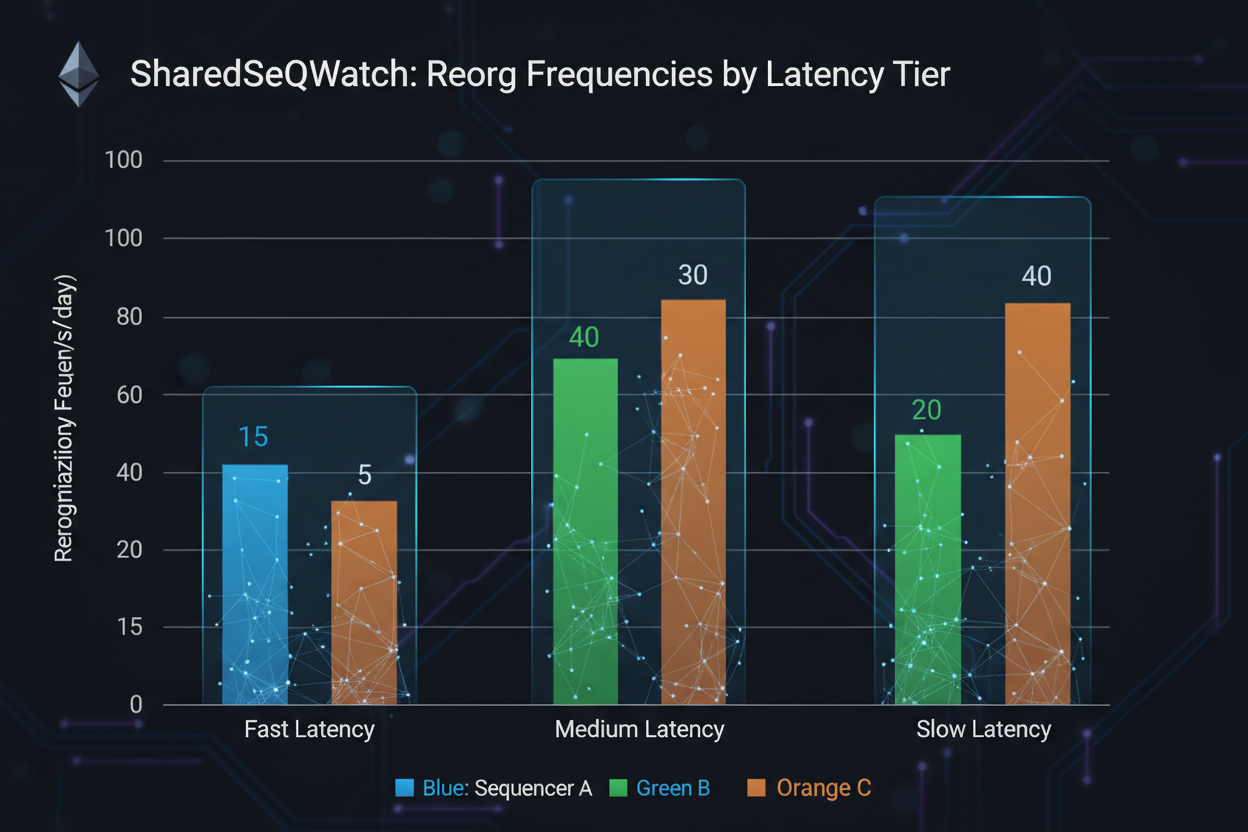
Real-world ethereum l2 performance metrics from SharedSeqWatch. com underscore slow tiers' resilience: during January 2026 congestion spikes, they logged 30% fewer censorship events than faster counterparts, per denial-of-sequencing attack simulations. This tier's cost-effectiveness stems from leveraging Ethereum's native validators, slashing operational overhead by 50% versus proprietary fast setups.
Cross-Tier Benchmarks: Reorgs, Fairness, and Throughput Data
Dissecting shared sequencer monitoring data across tiers reveals quantifiable patterns. Fast tiers dominate DeFi throughput at 20-25 TPS but flirt with centralization vulnerabilities. Medium strikes equilibrium, hitting 15 TPS with 0.5% reorgs, while slow tiers cap at 7-8 TPS yet boast sub-1% fairness violations under load.
| Tier | Latency | Reorg Rate | Fairness Score | Ideal Use Case |
|---|---|---|---|---|
| Fast ( and lt;100ms) | 50-90ms | and lt;0.1% | 95% | High-freq DeFi |
| Medium (100-500ms) | 150-400ms | 0.5% | 88% | General dApps |
| Slow ( and gt;500ms) | 600-900ms | 2% | 92% | Secure bridges |
These ethereum sequencer benchmarks, pulled from SharedSeqWatch. com's live dashboards, highlight how reorg risks scale inversely with speed. Fast tiers' advanced protocols, like ePBS from late 2025, clamp deviations, but medium and slow rely on restaking for deterrence, as Cube Exchange outlines in time-to-finality analyses.

Fairness Tradeoffs Deep Dive: From Speed to Security
Rollup fairness tradeoffs crystallize in incentive alignments. Fast tiers demand aggressive slashing to counter sequencer drift, incurring 2-3x higher economic security costs than slow tiers' validator diffusion. Arbitrum's censorship resistance models predict medium tiers optimal for 80% of rollups, balancing HotShot's sub-second finality with Zeeve's decentralization gains.
Opinion: Fast tiers thrill traders but mask fragility; witness Base-like UX in Fabric's based rollups, yet Ethereum Research warns of transition pitfalls without Maven 11-style aggregation. Slow tiers, though sluggish, fortify against DoS vectors in GitHub studies, proving cost-effective for long-tail scalability. Dencun's blobs and Scroll's Euclid slashed DA costs 90%, amplifying all tiers' viability at ETH's $1,968.05 anchor.
Cross-rollup atomicity, per Cryptonium insights, favors medium tiers for DeFi sprawl, reducing reorgs 40% via shared ordering. Stakeholders must weigh: DeFi picks fast for edge, enterprises slow for audits, generalists medium for scale. SharedSeqWatch. com's granular tracking- latency histograms, reorg heatmaps, fairness indices- empowers precise calibration. As L2 TVL climbs amid $1,968.05 ETH stability, these tiers delineate winners in the sequencing wars, where every millisecond charts the path to Ethereum's trillion-dollar throughput era.



No comments yet. Be the first to share your thoughts!