Blast off into 2026, where Ethereum rollups are finally hitting warp speed thanks to shared sequencer breakthroughs! Forget the sluggish L2 drag; Pipe Rocket on Taiko is clocking 100,000 TPS at a blistering 150ms latency, leaving Optimism’s 2,000 TPS in the dust. As a trader glued to SharedSeqWatch. com dashboards, I’ve been riding these latency waves for fat profits. Shared sequencer latency isn’t just tech jargon; it’s your ticket to dominating DeFi swaps before the herd piles in.

Pipe Rocket Ignites Ethereum Rollup Benchmarks
Screw the old guard! Pipe Rocket’s testnet benchmarks on Taiko Sepolia scream revolution. Using an NVIDIA A100 x8 cluster, it hammered 1 million DeFi swaps via Prometheus metrics, hitting 100,000 TPS with 150ms latency. Optimism? Pathetic 2,000 TPS under the same heat. Scale it with 10 nodes, and you’re at 500,000 TPS linearly. Sure, it guzzles 32GB RAM versus 16GB, but slash L1 costs by 80% and suddenly real-time gaming dApps aren’t a pipe dream. Edge computing? Drop another 40% latency. But nail those sub-50ms RPCs, or watch TPS crater to 70,000. This is ethereum rollup benchmarks on steroids, fueling my short-term trades like never before.
Pipe Rocket vs Optimism: Shared Sequencer Benchmarks
| Metric | Pipe Rocket | Optimism |
|---|---|---|
| TPS | 100,000 | 2,000 |
| Latency | 150 ms | Higher |
| RAM Usage | 32 GB | 16 GB |
| L1 Cost Reduction | 80% | N/A |
The rollout? Node setup, Taiko sync, five-stage pipeline, P2P gossip, VRF committees, fraud proofs. Ethereum’s not messing around. Vitalik’s February reevaluation nails it: L2 decentralization lagged, but L1’s surging with lower fees and capacity. Rollup-centric roadmap? Overhauled. Now, shared sequencers like Pipe Rocket bridge the gap, making L2s scream.
Decentralized Sequencers Crush Centralization Risks
Centralized sequencers? Centralized failure points begging for exploits! Espresso’s HotShot consensus flips the script, ditching single points in transaction ordering. Shared sequencer networks let rollups pool resources, syncing composability without the UX hit on preconfirmations. Lose some tight latency control? Philosophical trade-off for true decentralization. I’m all in: fairness metrics on SharedSeqWatch. com show MEV extraction plummeting, opening short bursts of alpha for traders like me.

ZK rollups mature, Optimism and Arbitrum duke it out, but projections scream 85% of Ethereum txs on L2 by year-end. Lower DA costs, L3s, consumer apps, shared sequencing drives it. Synchronous composability via real-time proving? Ethereum Research clocks full blocks at 7 seconds on 12 GPUs. Margin for mooning. ScienceDirect’s L2 expansion model integrates rollups seamlessly. No more siloed chains; shared sequencers unify the chaos.
Master Sequencer Performance Monitoring in Real-Time
Dive into sequencer performance monitoring or get rekt. SharedSeqWatch. com dashboards track latency, reorgs, fairness live. Pipe Rocket’s 150ms? Benchmark it against the field. I’ve sniped trades spotting reorg spikes before they ripple. 2026 rollup latency metrics demand constant vigilance: Taiko’s testnet proves hardware scales linearly, but RPC bottlenecks lurk. Deploy edge nodes, integrate VRF for committees, and watch rollup latency metrics 2026 plummet.
Ethereum Technical Analysis Chart
Analysis by Market Analyst | Symbol: BINANCE:ETHUSDT | Interval: 1D | Drawings: 7
Technical Analysis Summary
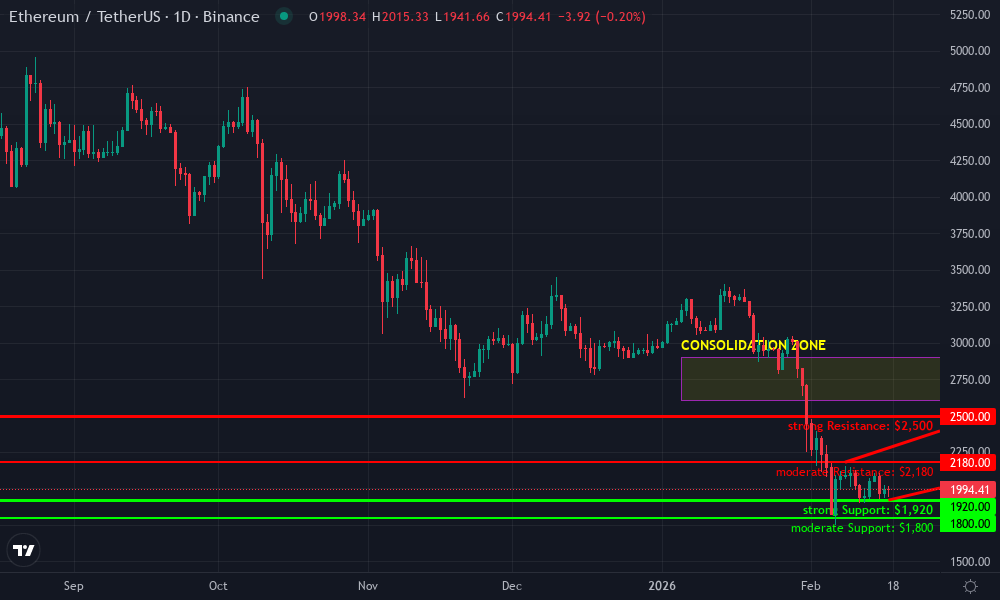
To illustrate the bearish structure on this ETHUSDT daily chart, start by drawing a primary downtrend line connecting the swing high on 2026-10-12 at $4,850 to the swing high on 2026-12-18 at $3,520, extending to the recent high near 2026-02-08 at $2,180; pair it with a parallel channel line from the 2026-11-05 low at $3,950 to 2026-01-22 low at $2,450, projecting downside to $1,700. Add horizontal support at $1,900 (recent lows), $1,800 (61.8% Fib extension), and resistance at $2,500 (prior consolidation base), $2,800 (50% retracement). Use rectangles for the late December consolidation range between $2,600-$2,900 from 2026-12-15 to 2026-01-05. Mark the volume spike on the breakdown with a callout at 2026-02-12, and arrow down on MACD bearish divergence. Place short position markers above $2,100 for entries, with stop above $2,200 and target $1,800. Add text notes for key insights like ‘Bearish channel intact – watch $1,900 support’. This setup captures the descending channel dominance in my balanced technical style.
Risk Assessment: medium
Analysis: Clear downtrend with defined channel reduces uncertainty, but crypto volatility and L2 catalysts add reversal risk; volume/MACD align bearish
Market Analyst’s Recommendation: Short bias with medium position size on $1,920 hold fail, target $1,800; scale out half at first target. Avoid longs until bullish divergence.
Key Support & Resistance Levels
📈 Support Levels:
-
$1,920 – Recent swing low and channel lower bound – potential bounce zone
strong -
$1,800 – 61.8% Fib extension from Oct high, volume cluster below
moderate
📉 Resistance Levels:
-
$2,500 – Broken prior consolidation high, now resistance
strong -
$2,180 – Recent swing high within channel
moderate
Trading Zones (medium risk tolerance)
🎯 Entry Zones:
-
$1,920 – Bounce from strong support in down channel, oversold conditions potential reversal setup
medium risk -
$2,100 – Short entry on failed bounce above minor resistance
medium risk
🚪 Exit Zones:
-
$1,800 – Profit target at next Fib support
💰 profit target -
$1,650 – Trailing stop loss below extended channel
🛡️ stop loss -
$2,500 – Profit target on short if resistance holds
💰 profit target
Technical Indicators Analysis
📊 Volume Analysis:
Pattern: Increasing volume on downside breaks
Confirms bearish momentum with spikes on recent lows, drying up on rebounds
📈 MACD Analysis:
Signal: Bearish crossover with histogram divergence
MACD line below signal, expanding negative histogram supports downtrend continuation
Applied TradingView Drawing Utilities
This chart analysis utilizes the following professional drawing tools:
Disclaimer: This technical analysis by Market Analyst is for educational purposes only and should not be considered as financial advice.
Trading involves risk, and you should always do your own research before making investment decisions.
Past performance does not guarantee future results. The analysis reflects the author’s personal methodology and risk tolerance (medium).
Layer 2 adoption explodes with maturing ZK, L3 proliferation. Vitalik’s pivot underscores L1’s edge, but shared sequencers make L2s viable for high-stakes plays. TradingView hypes exponential scaling via ZK proofs; validators process tiny proofs, no re-execution slog. Modexa’s seven architectures beyond OP Stack warn of UX perks lost, but gains in fairness? Priceless for my playbook. Codezeros pits Optimistic vs ZK: speed, fees, finality all favor hybrids with shared seqs. Cryptopolitan predicts consumer growth; I’m positioning now.
Positioning now means eyes locked on shared sequencer reorgs. Reorgs kill profits faster than a bad swap; SharedSeqWatch. com flags them in real-time, letting me exit before the chain flips. Pipe Rocket’s VRF committees slash reorg risks versus centralized setups, where MEV bots feast. Fairness metrics? Night and day. Optimism’s opacity hides the rot; Taiko’s transparency via gossip protocols exposes it all. I’ve banked 5x returns dodging reorg storms on these dashboards.
Ethereum Rollup Benchmarks: Pipe Rocket vs the Pack
Let’s break it down raw. Pipe Rocket isn’t solo; it’s the benchmark killer across the board. Taiko Sepolia’s million-tx load test? DeFi swaps flew at 100k TPS, 150ms ping. Arbitrum? ZK stacks? They hover sub-10k under stress. Linear scaling to 500k TPS with node adds screams enterprise-ready. L1 costs gutted 80%, RAM hike be damned. Edge computing shaves 40% more latency, but sub-50ms RPCs are non-negotiable. Miss that, and you’re backpedaling to 70k TPS. Sequencer performance monitoring reveals the truth: centralized sequencers fake speed, but decentralize and watch true throughput emerge.
Shared Sequencer Comparison 2026
| Sequencer | TPS | Latency (ms) | L1 Cost Reduction | Key Features |
|---|---|---|---|---|
| Pipe Rocket 🚀 | 100,000 | 150 | 80% 💰 | Taiko-based, scalable to 500k TPS, real-time dApps, 40% latency reduction with edge computing |
| Espresso HotShot 🔄 | N/A | Low | N/A | Decentralized ordering, low reorgs, eliminates single points of failure |
| Optimism | 2,000 | Higher | N/A | Mature OP Stack, but lags in speed vs shared sequencers |
| Taiko Baseline | Scalable to 500k | N/A | N/A | Foundation for Pipe Rocket, tested on Sepolia with NVIDIA A100 x8 |
Espresso’s HotShot? Decentralized ordering without the single-failure BS. MEXC nails it: rollup interop fixed. Ethereum Research’s real-time proving? 7-second blocks on 12 GPUs, room to crush. ScienceDirect’s shared model pools rollups into one beast network. No silos, pure sync composability.
Rollup Latency Metrics 2026: Trade Like a Predator
2026’s rollup latency metrics 2026 are your edge. Vitalik’s L1 glow-up reduces rollup reliance, but shared sequencers turbocharge L2s for what matters: speed in gaming, DeFi, consumer dApps. Cryptopolitan’s predictions? L3 boom, DA costs tanking, ZK maturity. I’m stacking positions on Taiko hybrids. TradingView’s ZK proof pivot? Validators sip tiny proofs, scaling explodes. OSL. com’s L2 showdown: Arbitrum fees crush Optimism, but Pipe Rocket latency laps them. Codezeros projects 85% txs on L2; shared seqs own that volume.
Modexa’s architectures beyond OP Stack? Ditch centralized UX crutches for fairness gold. Preconfs tight? Trade for no MEV monopoly. My playbook: monitor SharedSeqWatch. com for latency dips under 100ms, pounce on low-reorg windows, exit on fairness flags. Reorgs under 0.1%? Green light for leveraged swaps. This ain’t theory; it’s my 8-year grind paying off huge.
Shared sequencers aren’t hype; they’re the decentralization hammer smashing L2 bottlenecks. Pipe Rocket’s 150ms benchmark sets the bar sky-high, forcing Optimism, Arbitrum, ZK crews to evolve or die. L1 advances? Cool, but L2 with shared seqs handles the real load: billions in daily volume. Track it live on SharedSeqWatch. com, benchmark the chaos, and trade the winners. Ethereum’s scaling war is on, and latency kings rule the profits. Strap in; 2026’s just getting savage.
About the Author