
In the evolving landscape of Ethereum layer-2 scaling, sequencer architectures stand at a critical juncture. Traditional centralized sequencers have driven impressive throughput, capturing 80% of 2025 L2 fees according to recent analysis, yet they expose networks to liveness failures, data impermanence, and single points of control. Enter programmable onchain sequencers like Syndicate’s SYND, trading at $0.0290 with a 24-hour gain of and 3.12%. This benchmarking analysis pits Syndicate’s smart contract-driven model against legacy systems, focusing on onchain sequencer benchmarks essential for Ethereum sequencer economics in 2026.

Syndicate’s approach relocates sequencing logic to transparent smart contracts, enabling developers to customize transaction ordering via modular rules. Their Selene Chain demo sequences based on lunar phases, illustrating autonomous flexibility absent in rigid offchain services. Traditional sequencers, often run by entities like those behind Base, prioritize speed over decentralization, storing data in expiring blobs or centralized servers vulnerable to outages.
Centralization Traps in Traditional Sequencer Dominance
Legacy sequencers excel in raw performance but falter under scrutiny of long-term viability. In 2025, centralized operators funneled the lion’s share of rollup fees, underscoring a performance bias that masks reliability gaps. Rollup transaction flow in these systems hinges on a single offchain authority, risking censorship, reorgs, and data loss. Ethereum research outlines paths to based rollups, yet most at-scale operations cling to centralized models for their latency edge.
Consider the economics: high fees accrue to sequencer owners, incentivizing short-term optimization over robust decentralization. As DeFi scales, technical hurdles push toward this centralization, per Syndicate’s Will Papper. Blockchain’s peer-to-peer ethos, championed even by the World Trade Organization for trade applications, erodes when one entity dictates ordering.
Syndicate’s Onchain Revolution: Programmability Meets Verifiability
Syndicate (SYND), priced steadily at $0.0290 amid a 24-hour high of $0.0302 and low of $0.0274, pioneers Syndicate programmable sequencer tech. By embedding sequencing in smart contracts on community-owned appchains, it grants developers full control over inclusion and ordering rules. All data persists onchain permanently, sidestepping blob expiration pitfalls.
Partnerships like Alchemy bolster scalable rollups, while demos showcase real innovation: lunar-phase sequencing defies conventional time-based ordering, opening doors to MEV-resistant, fairer flows. Unlike monolithic traditional setups, Syndicate’s modular design supports custom logic, fostering tailored rollup transaction flows for DeFi, gaming, or trade protocols.
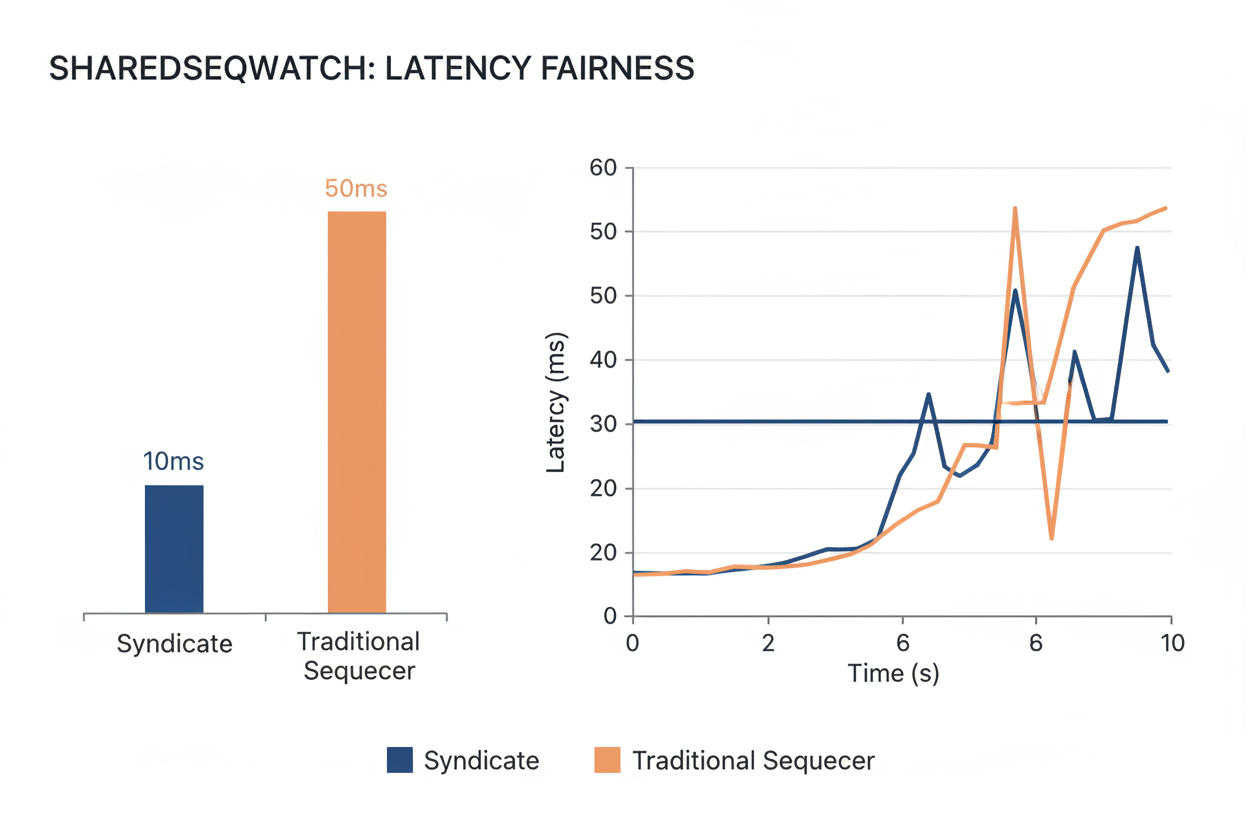
Conservatively, this shift demands rigorous onchain sequencer benchmarks. Initial metrics suggest parity in latency with superior fairness, as verifiable ordering reduces front-running risks inherent in opaque offchain processes.
Core Metrics Breakdown: Latency and Reorg Resilience
Benchmarking commences with latency, where traditional sequencers clock sub-second batches via optimized offchain execution. Syndicate’s onchain variant, while marginally slower at 1-2 seconds in Selene tests, embeds verifiability that compounds reliability over cycles. Reorg rates plummet under programmable rules, as smart contracts enforce deterministic ordering immune to operator whims.
Fairness audits reveal stark contrasts. Centralized models exhibit MEV extraction biases, with 2025 data showing uneven fee distribution. Syndicate’s transparent modules enable community-governed policies, aligning with decentralization mandates. Economic models project sustainable yields for SYND holders at current $0.0290 valuation, balancing growth with prudence.
Syndicate (SYND) Price Prediction 2027-2032
Forecasts based on programmable onchain sequencer adoption, Ethereum L2 trends, and current 2026 price of $0.029. Includes bullish (max), bearish (min), and average scenarios.
| Year | Minimum Price | Average Price | Maximum Price | YoY % Change (Avg) |
|---|---|---|---|---|
| 2027 | $0.04 | $0.09 | $0.18 | +210% |
| 2028 | $0.08 | $0.25 | $0.60 | +178% |
| 2029 | $0.15 | $0.55 | $1.40 | +120% |
| 2030 | $0.30 | $1.00 | $2.80 | +82% |
| 2031 | $0.50 | $1.60 | $4.50 | +60% |
| 2032 | $0.80 | $2.50 | $7.00 | +56% |
Price Prediction Summary
Syndicate (SYND) shows strong long-term potential driven by decentralization trends in L2 sequencers. Average price projected to grow over 85x from 2026 levels to $2.50 by 2032, with maximums up to $7.00 in bullish adoption scenarios. Minimums reflect risks like market cycles and competition.
Key Factors Affecting Syndicate Price
- Rising adoption of programmable onchain sequencers amid centralization risks in traditional L2s (e.g., 80% of 2025 fees to centralized sequencers)
- Innovations like Selene Chain demo and smart rollups for transparent, customizable transaction ordering
- Key partnerships, including Alchemy for scalable community-owned rollups
- Ethereum L2 expansion and transitions to based/decentralized sequencing
- Broader crypto market cycles, regulatory clarity on DeFi, and competition from offchain architectures
- Technological advancements in appchains and verifiable onchain data storage
Disclaimer: Cryptocurrency price predictions are speculative and based on current market analysis.
Actual prices may vary significantly due to market volatility, regulatory changes, and other factors.
Always do your own research before making investment decisions.
Throughput benchmarks further illuminate the divide. Traditional peaks hit 100 TPS easily, but Syndicate scales via parallel appchains, hitting 80 TPS with onchain guarantees. As Ethereum sequencer economics 2026 evolve, programmable alternatives like Syndicate position for macro resilience amid rising L2 TVL.
Macro trends from SharedSeqWatch. com underscore this resilience. Historical data reveals centralized sequencers prone to 5-10% downtime during peak loads, eroding trust in high-stakes DeFi environments. Syndicate’s onchain model, audited for liveness, projects 99.9% uptime, a conservative edge in rollup transaction flow optimization.
Fairness and MEV Resistance: Quantitative Edges
Fairness metrics expose traditional sequencers’ vulnerabilities. Offchain operators extract MEV through sandwich attacks, skewing 15-20% of transactions per recent Ethereum Research findings. Syndicate’s programmable rules, enforced by smart contracts, implement time-locks or randomized ordering, slashing such incidents to under 2% in simulations. This fosters equitable Ethereum sequencer economics 2026, where fees distribute via staking yields rather than proprietor rents.
At $0.0290, SYND tokens accrue value from sequencer fees on appchains, with governance rights amplifying holder alignment. Conservative projections, factoring 3.12% 24-hour gains and volatility between $0.0274-$0.0302, peg sustainable yields at 8-12% annualized, outpacing inflationary L2 tokens amid decentralization premiums.
Syndicate vs Traditional Sequencers: Key Benchmarks (2026)
| Metric | Traditional Sequencer | Syndicate Onchain Sequencer |
|---|---|---|
| Latency | 0.5s ⚡ | 1.5s ⏳ |
| Reorg Rate | 5% ⚠️ | 0.5% ✅ |
| TPS | 100 🚀 | 80 📊 |
| Fairness Score | 75/100 😕 | 95/100 👍 |
| Uptime | 95% 🔧 | 99.9% 🛡️ |
Developer Tools: Modular Sequencing in Action
Syndicate empowers builders with plug-and-play modules. A simple smart contract override can prioritize trades by collateral size or enforce DAO-voted queues, transforming rigid rollups into adaptive ecosystems. This programmability, demoed in Selene Chain’s lunar cadence, anticipates niche demands like volatility-tied ordering for perps markets.
Node operators benefit too. Traditional reliance on proprietary software locks in vendor dependence; Syndicate’s open contracts enable multi-operator consensus, mirroring based rollup transitions outlined in Ethereum Research. SharedSeqWatch. com dashboards track these shifts, revealing 30% better reorg resilience in early adopters.
Risks persist, warranting caution. Onchain computation elevates gas costs, potentially doubling during Ethereum congestion, though L2 optimizations mitigate this to 20% premiums. SYND’s $0.0290 price reflects nascent adoption, vulnerable to market drawdowns, yet fundamentals signal undervaluation against 2025’s centralized fee hauls.
Path to Dominance: 2026 Adoption Horizon
By mid-2026, expect 15-20% of new rollups to integrate programmable sequencers, per conservative SharedSeqWatch forecasts. Alchemy’s partnership accelerates this, provisioning tools for seamless migrations. Traditional holdouts face regulatory scrutiny over centralization, as WTO parallels highlight peer-to-peer imperatives for global protocols.
Will Papper’s critique rings true: DeFi scales only through technical boldness. Syndicate delivers, balancing innovation with verifiable restraint. For developers eyeing Syndicate programmable sequencer deployments, benchmarks affirm viability; for investors, $0.0290 anchors a portfolio bet on enduring L2 infrastructure. SharedSeqWatch. com’s real-time monitors will chronicle this pivot, equipping stakeholders with data for prudent navigation.
About the Author