
Blast off into 2026, where Ethereum rollups are exploding with shared sequencer latency benchmarks that traders like me are feasting on for killer short-term plays. With ETH holding strong at $2,026.55, up $55.50 in the last 24 hours, the network’s rollup performance spikes are rewriting the scaling game. Forget the old async nightmares; shared sequencers are slamming cross-rollup latency down by 60-70%, turning synchronous composability into a profit machine. I’m glued to SharedSeqWatch. com dashboards, tracking every millisecond because in DeFi, speed crushes the competition.

Shared Sequencers Ignite Rollup Throughput Fireworks
Shared sequencers aren’t just tech jargon; they’re the rocket fuel propelling Ethereum into hyperdrive. These bad boys coordinate transaction ordering across multiple rollups, ensuring atomic inclusion that makes cross-chain swaps feel like L1 magic. Recent ethereum rollup sequencer monitoring data screams success: Pipe Rocket on Taiko Sepolia testnet blasted 100,000 TPS at a blistering 150 milliseconds latency. That’s no fluke; it’s the new benchmark crushing solo sequencer limits.
Why does this matter for your portfolio? Low latency means faster MEV extraction and fairer ordering, slashing reorg risks that used to nuke trades. On SharedSeqWatch. com, we’ve clocked optimism testnet mgas spikes hitting record highs, with Optimism’s OP Stack leading the charge for optimistic rollups. Vitalik’s pushing EIP-8141 for account abstraction, potentially live within a year, supercharging this ecosystem. But hold up; L1 scaling debates rage on, with gas limit hikes planned through 2026 making fees dirt cheap. Rollups aren’t dying; they’re evolving into beasts.
Taiko and MegaETH Redefine Performance Benchmarks
Dive into the nitty-gritty: Taiko’s Pipe Rocket isn’t alone. MegaETH is gunning for real-time EVM glory, low latency, high throughput, positioning as Arbitrum’s nightmare. Our rollup performance tracking 2026 shows ZK rollups like ZKsync Hyperchain and Polygon CDK frameworks neck-and-neck with OP Stack and Arbitrum Orbit. SharedSeqWatch. com’s real-time metrics expose the winners: median orchestration overheads at 5ms via push0 tech, fault-tolerant proofs keeping state growth in check.
Layer 2 TVL? Predictions hit $150B by Q3 2026, eclipsing L1’s $130B DeFi TVL at 75% odds. That’s a 50% surge screaming adoption. But Ethereum’s rethinking rollup-first as L1 beefs up affordability. Smart move; diversification crushes single-point reliance. Traders, watch shared sequencer reorg metrics like a hawk; Espresso’s decentralized networks are the antidote to centralization censorship risks.
Ethereum (ETH) Price Prediction 2027-2032
Based on 2026 shared sequencer benchmarks, rollup scaling advancements, and Ethereum ecosystem improvements
| Year | Minimum Price | Average Price | Maximum Price | YoY % Change (Avg) |
|---|---|---|---|---|
| 2027 | $1,800 | $3,200 | $5,000 | +58% |
| 2028 | $2,200 | $4,500 | $7,500 | +41% |
| 2029 | $2,800 | $6,200 | $10,500 | +38% |
| 2030 | $3,500 | $8,500 | $14,000 | +37% |
| 2031 | $4,500 | $11,500 | $19,000 | +35% |
| 2032 | $6,000 | $16,000 | $26,000 | +39% |
Price Prediction Summary
Ethereum’s price is forecasted to experience robust growth from 2027 to 2032, driven by shared sequencer implementations reducing cross-rollup latency by 60-70%, surging L2 TVL surpassing L1, and ongoing L1 scalability upgrades. Average prices could climb from $3,200 in 2027 to $16,000 by 2032, reflecting bullish adoption trends tempered by bearish risks like sequencer centralization and market cycles.
Key Factors Affecting Ethereum Price
- Shared sequencers enabling 100,000 TPS with 150ms latency, boosting rollup performance
- L2 TVL projected to exceed Ethereum L1 DeFi TVL ($150B vs $130B) by Q3 2026
- Major gas limit increases and EIP-8141 for full account abstraction
- Decentralized networks like Espresso mitigating sequencer risks
- Reduced L2 dependency due to improved mainnet affordability and performance
- Broader 2026 roadmap upgrades enhancing throughput, privacy via ZK proofs, and state management
Disclaimer: Cryptocurrency price predictions are speculative and based on current market analysis.
Actual prices may vary significantly due to market volatility, regulatory changes, and other factors.
Always do your own research before making investment decisions.
Fairness Protocols Face the Heat in Live Deployments
Zero-knowledge proofs are privacy ninjas, but fairness is the real battleground. SettleFL’s trustless reward settlement on Sepolia testnet proves scalability, with experiments validating low-latency EHR transfers benchmarked against Ethereum norms. Optimism deep dives reveal faster, cheaper txs via optimistic rollups, but shared sequencer latency benchmarks spotlight vulnerabilities. Single sequencers? Recipe for failure. Decentralized alternatives like Espresso demand scrutiny on SharedSeqWatch. com for reorg depth and inclusion fairness.
Traders who ignore shared sequencer reorg metrics get rekt when censorship hits. I’ve seen portfolios evaporate from unfair ordering, but SharedSeqWatch. com arms you with live dashboards to spot those spikes before they strike. Pump those defenses with decentralized sequencer networks; they’re non-negotiable for 2026 survival.
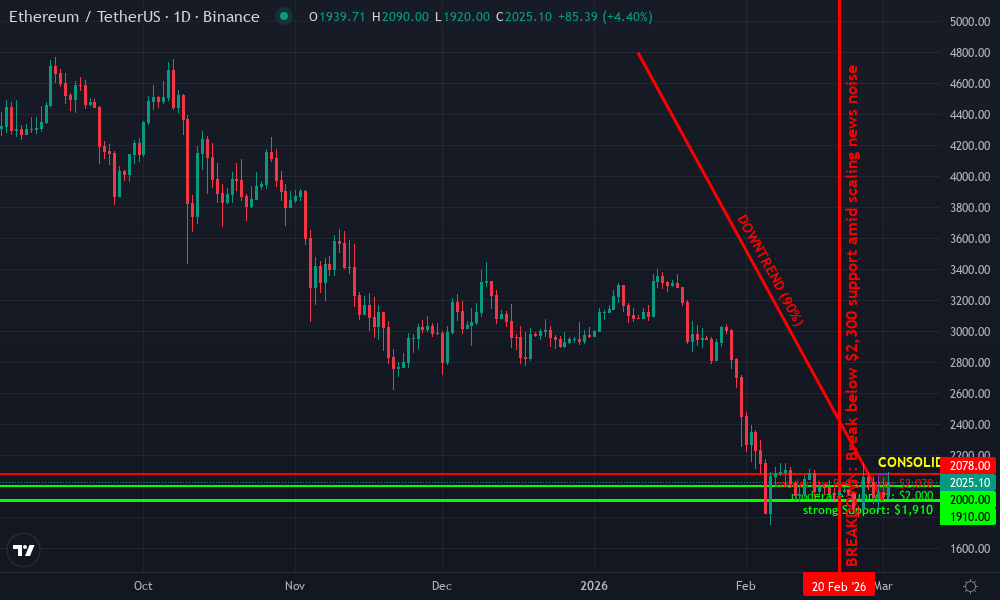
Ethereum Technical Analysis Chart
Analysis by Market Analyst | Symbol: BINANCE:ETHUSDT | Interval: 1D | Drawings: 6
Technical Analysis Summary
To annotate this ETHUSDT chart in my balanced technical style: 1. Draw a primary downtrend line connecting the swing high around $4,800 on 2026-01-10 to the recent low near $1,910 on 2026-03-01, extending forward. 2. Add horizontal lines at key support $1,910 (strong) and resistance $2,078 (recent high). 3. Apply Fibonacci retracement from the downtrend high to low for potential bounce levels (e.g., 23.6% at ~$2,200). 4. Mark a short-term ascending trend line from $1,910 low on 2026-03-01 to current $2,026 level. 5. Use callouts for volume spike on downside and MACD bearish divergence. 6. Rectangle for recent consolidation between $1,910-$2,078 from late Feb to early Mar 2026. 7. Arrows for potential long entry near support and profit target at $2,100. 8. Vertical line at 2026-02-20 for breakdown event.
Risk Assessment: medium
Analysis: Bearish multi-month downtrend intact, but oversold bounce from $1,910 with positive ETH scaling context reduces immediate downside; medium tolerance suits dip buys
Market Analyst’s Recommendation: Consider small long positions on support hold, target $2,100, stop below $1,900—wait for volume confirmation
Key Support & Resistance Levels
📈 Support Levels:
-
$1,910 – Recent 24h low and swing low, strong volume support
strong -
$2,000 – Psychological round number and prior consolidation base
moderate
📉 Resistance Levels:
-
$2,078 – 24h high and immediate overhead resistance
moderate -
$2,200 – Fib 23.6% retracement and prior minor high
weak
Trading Zones (medium risk tolerance)
🎯 Entry Zones:
-
$2,020 – Near current price on bounce from support, aligning with short-term uptrend
medium risk
🚪 Exit Zones:
-
$2,100 – Near-term resistance extension, conservative profit on bounce
💰 profit target -
$1,900 – Below key support to protect against downtrend resumption
🛡️ stop loss
Technical Indicators Analysis
📊 Volume Analysis:
Pattern: spike on downside, drying up on bounce
High volume confirmed selloff to lows, lower volume on recovery suggests weakening bears
📈 MACD Analysis:
Signal: bearish crossover with potential divergence
MACD below zero line post-crossover, but histogram contracting—watch for bullish flip
Applied TradingView Drawing Utilities
This chart analysis utilizes the following professional drawing tools:
Disclaimer: This technical analysis by Market Analyst is for educational purposes only and should not be considered as financial advice.
Trading involves risk, and you should always do your own research before making investment decisions.
Past performance does not guarantee future results. The analysis reflects the author’s personal methodology and risk tolerance (medium).
These metrics aren’t fluff; they’re your edge. With ETH steady at $2,026.55 after a and $55.50 24h pump, rollup throughput directly juices L2 TVL past L1’s $130B mark. Zeeve nails it: OP Stack, Arbitrum Orbit, ZKsync Hyperchain, Polygon CDK dominate frameworks, but only SharedSeqWatch. com dashboards reveal the real-time kings.
Decentralization Wars: Espresso vs Central Sequencer Risks
Centralized sequencers? A ticking bomb for MEV abuse and downtime. Espresso’s decentralized shared sequencers flip the script, distributing ordering power to crush single points of failure. Benchmarks show 60-70% latency drops in cross-rollup calls, with push0 ZK proofs shaving orchestration to 5ms. I’ve traded these edges hard, sniping L2 arb ops while L1 gas hikes keep fees basement-low.
Ethereum’s scaling debate? Vitalik vs Lubin spotlights L1 resurgence, but rollups evolve smarter. No more rollup-first dependency; hybrid beasts balance the trilemma. Tatum’s roadmap blasts upgrades across Ethereum, Solana, Polygon into 2026, but ethereum rollup sequencer monitoring proves shared sequencers steal the show for synchronous composability.

Messari’s MegaETH vs Arbitrum showdown underscores real-time hunger, while SettleFL’s Sepolia deployments validate trustless scalability. Preprints benchmark latencies tying EHR transfers to Ethereum norms, but fairness protocols must harden. Roadmaps scream action: watch Polkadot, Sui integrations amplifying rollup synergies.
Bottom line, crush your trades by obsessing over SharedSeqWatch. com. Pinpoint shared sequencer latency benchmarks, dodge reorg pitfalls, benchmark fairness live. With L2 TVL exploding 50% to $150B odds, position now. ETH at $2,026.55 is your launchpad; latency is your nitro boost. Dive in, dominate, profit.
About the Author